Pennsylvania Dog Registration Information
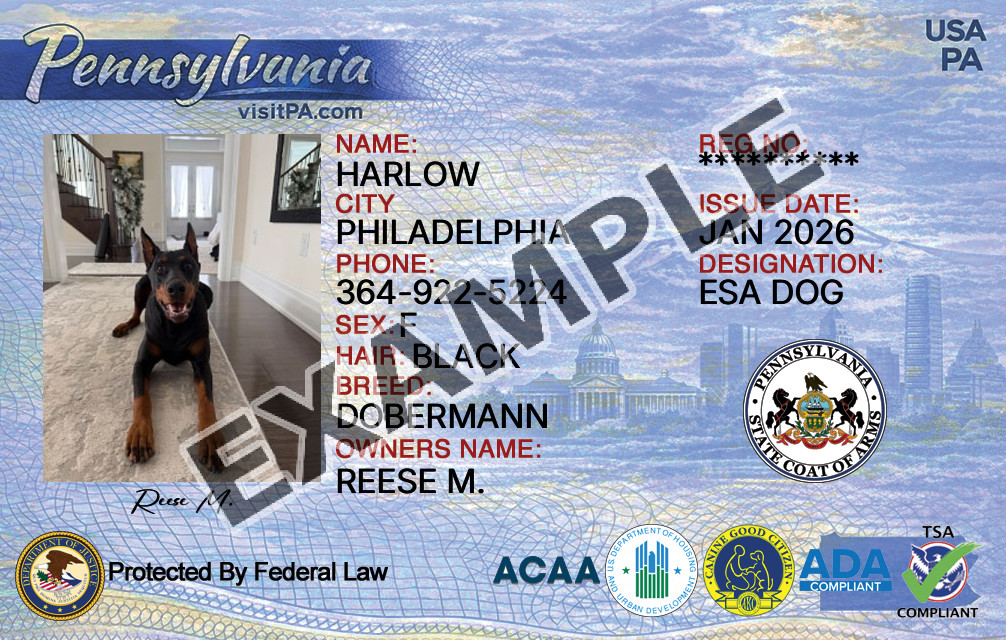
State Licensed, Service Dogs and Emotional Support Dogs in Pennsylvania
If you are searching for how to register my dog in Pennsylvania, the most important thing to know is that Pennsylvania dog licensing is required by state law but handled mostly through local county offices. In most cases, a dog license in Pennsylvania is purchased through your county treasurer or an authorized county issuing agent. That means there is a statewide legal framework, but the actual buying process is usually local and county-based rather than handled by one universal office counter for every resident.
This local structure is why many owners search for where to register a dog in Pennsylvania and see different county offices depending on where they live. Pennsylvania also connects dog licensing closely to rabies control. Dogs must be currently vaccinated for rabies under state law, and local officials, county offices, and Pennsylvania dog wardens all play a role in enforcement. If you are trying to understand animal control dog license Pennsylvania rules, think of the system in three parts: the county treasurer or issuing agent for the license, local or state enforcement for compliance, and rabies rules that support public health.
Where to Register or License Your Dog in Pennsylvania
Because licensing is often handled at the county level, the offices below are examples of official Pennsylvania county offices that issue dog licenses or help owners complete the process. Your correct office usually depends on the county where the dog resides.
Bucks County Treasurer's Office
55 E Court Street, 5th Floor
Doylestown, PA 18901
Phone: 215-348-6244
Email: treasurer@buckscounty.org
Office Hours: Monday through Friday 8:15 am to 4:15 pm
Dauphin County Treasurer
101 Market Street, Room 105
Harrisburg, PA 17101
Phone: 717-780-6550
Email: treasurer@dauphincounty.gov
Office Hours: Not clearly listed on the contact page; verify before visiting
Lancaster County Treasurer
Lancaster County Government Center
150 N Queen Street, Suite 122
Lancaster, PA 17603
Phone: 717-299-8222
Email: Treasurer office email available through official county directory
Office Hours: Monday through Friday 8:30 am to 5:00 pm
Delaware County Treasurer License Department
Government Center Building, Ground Floor
201 W Front Street
Media, PA 19063
Phone: 610-891-4271
Email: Available through the Treasurer's Office contact page
Office Hours: Monday through Friday 8:30 am to 4:30 pm
Erie County Bureau of Revenue Dog Licenses
Erie County Courthouse
140 West 6th Street, Room 109
Erie, PA 16501
Phone: 814-451-6239
Email: doglicenses@eriecountypa.gov
Office Hours: Not clearly listed on the dog license page; county offices commonly operate Monday through Friday daytime hours
Montgomery County Treasurer
One Montgomery Plaza, 6th Floor
Norristown, PA 19401
Phone: 610-278-3066
Email: Treasurer contact listed through the official county treasurer page
Office Hours: Monday through Friday 8:30 am to 4:15 pm
Overview of Dog Licensing in Pennsylvania
Pennsylvania requires dog licenses by state law
Pennsylvania law requires most dogs to be licensed. State guidance explains that all dogs three months of age or older must be licensed, and owners can buy an annual or lifetime license through the county treasurer or an authorized issuing agent. This is one of the clearest answers to the question how to register my dog in Pennsylvania. The state creates the legal requirement, but the county handles the front-end process for most residents.
County treasurers are the usual licensing office
In day-to-day practice, most owners get a dog license in Pennsylvania from the county treasurer. Some counties also allow approved issuing agents to sell annual licenses. The county treasurer remains the central official office for the program, especially for lifetime licenses, duplicates, transfers, and other formal license records. That county-based system is why the correct answer to where to register a dog in Pennsylvania depends on the county where your dog lives.
Annual and lifetime licenses
Pennsylvania offers both annual and lifetime dog licenses. Annual licenses usually need to be renewed each calendar year. Lifetime licenses are available for qualified dogs, but they generally require permanent identification such as a microchip or tattoo and supporting paperwork. Owners who want the simplest option often start with an annual license, while owners planning long-term compliance for one dog may consider the lifetime license if the dog meets the requirements.
Why licensing matters
Licensing is not just a formality. A valid license helps connect a lost dog to its owner faster and supports enforcement work involving stray dogs, dangerous dog cases, and dog wardens. Pennsylvania also warns that failing to license a dog can lead to a citation and fines. In practical terms, licensing protects both the owner and the community by creating a legal and traceable record of ownership.
Rabies rules are connected to licensing
Pennsylvania also requires dogs and cats three months of age or older to have a current rabies vaccination. State guidance says dogs must be vaccinated within four weeks after reaching twelve weeks of age and then must maintain current immunity according to vaccine requirements. This is why rabies documentation is an essential part of responsible ownership even when your county licensing form focuses mainly on license type and fees.
How Dog Licensing Works Locally in Pennsylvania
The county where you live usually controls the process
The most important local rule is county residence. If you want to know where to register a dog in Pennsylvania, you usually start with the county treasurer in the county where the dog lives. One owner may use Bucks County, another may use Dauphin County, and another may use Erie County. Even though the basic state law is the same, the customer experience can vary depending on which county office or authorized agent you use.
A typical step by step process
- Confirm that your dog is at least three months old or otherwise old enough to require licensing.
- Make sure your dog has current rabies vaccination documentation.
- Find the county treasurer or authorized issuing agent that serves your county.
- Complete the annual or lifetime dog license application.
- Provide any required supporting documents, such as rabies proof or permanent identification for a lifetime license.
- Pay the appropriate fee.
- Receive the license and tag, then keep the tag with the dog as required.
Primary agencies involved in Pennsylvania
The main offices involved in this process are county treasurers and authorized issuing agents. On the enforcement side, the Pennsylvania Department of Agriculture and its Bureau of Dog Law Enforcement play a major statewide role. State dog wardens help enforce dog law, respond to stray dog issues, and support rabies-related compliance. Municipal animal control officers may also be involved in local enforcement and public safety matters. This shared system explains why searches for animal control dog license Pennsylvania often bring up both county license offices and state dog law resources.
Rabies vaccination requirements in practice
Rabies compliance is one of the most important parts of lawful dog ownership in Pennsylvania. State guidance says dogs and cats three months of age or older must have a current rabies vaccination, and the Pennsylvania Department of Agriculture explains that vaccination must happen within four weeks after a dog reaches twelve weeks of age. Local officials, dog wardens, and other enforcement officers may ask for proof. That means owners should always keep their rabies certificate current and accessible.
County differences still matter
Even though Pennsylvania licensing is driven by statewide law, county offices can differ in their hours, forms of payment, online systems, mailing instructions, and availability of subagents. Some counties make over-the-counter licensing easy. Others push online and mail options more heavily. Some offices publish more detailed transfer and duplicate tag instructions than others. So while the legal framework is consistent statewide, the practical experience can still differ from one county to another.
Service Dog Laws in Pennsylvania
A dog license is not service dog status
One of the biggest misunderstandings owners have is thinking that a regular dog license creates service dog rights. It does not. A Pennsylvania dog license is a legal requirement for dog ownership and public safety compliance. Service dog legal status comes from disability law and the dog’s individual training to perform tasks for a person with a disability. A county license tag is not proof that a dog qualifies as a service animal under disability law.
What legally makes a dog a service dog
Under federal law, a service animal is generally a dog that has been individually trained to do work or perform tasks directly related to a person’s disability. The legal issue is the disability-related training and the handler’s need, not the county pet licensing process. A dog can be licensed without being a service dog, and a legitimate service dog may still need to follow routine licensing and rabies rules that apply generally to dogs.
Local compliance may still apply
Even when a dog is a legitimate service dog, ordinary dog ownership rules can still apply in many situations, including rabies vaccination and local licensing obligations. Service dog law and pet licensing answer different questions. One concerns disability access rights. The other concerns local and state regulation of dogs as animals living in the community.
Emotional Support Animal Rules in Pennsylvania
Emotional support animals are different from dog licenses
An emotional support animal is not the same as a county dog license. If your animal is a dog and Pennsylvania law requires it to be licensed, you generally still need a dog license in Pennsylvania even if the dog provides emotional support. Licensing is about lawful dog ownership, identification, and public safety. ESA status usually becomes relevant in housing or accommodation settings instead.
Emotional support animals are also different from service dogs
Emotional support animals do not have the same broad public access rights as trained service dogs. A service dog is defined by disability-related task training. An emotional support animal may provide comfort or support, but that does not automatically give it the same status in stores, restaurants, or other public places. This matters because some owners assume assistance-related paperwork replaces licensing duties. In most cases, it does not.
Housing issues are separate from licensing
Housing providers may need to consider disability-related accommodation requests involving assistance animals, including emotional support animals, under housing law. That is separate from the requirement to register and license your dog through the proper Pennsylvania county office. So if your main goal is learning how to register my dog in Pennsylvania, the right office is still your county treasurer or official county licensing agent.
Frequently Asked Questions
Do I register my dog with the State of Pennsylvania?
No. Pennsylvania law requires dog licensing, but most owners obtain the license through their local county treasurer or an authorized county issuing agent.
At what age does my dog need a license in Pennsylvania?
Dogs that are three months old or older must generally be licensed under Pennsylvania law.
Do I need proof of rabies vaccination?
Yes. Pennsylvania also requires dogs and cats three months of age or older to have a current rabies vaccination, and owners should keep proof available.
Can I get an annual or lifetime license?
Yes. Pennsylvania offers both annual and lifetime dog licenses, although lifetime licenses require additional documentation and permanent identification.
Who enforces dog law in Pennsylvania?
County offices issue licenses, while the Pennsylvania Department of Agriculture, its Bureau of Dog Law Enforcement, and state dog wardens help enforce dog laws and related compliance.
Is a dog license the same as service dog registration?
No. A dog license is a pet ownership requirement. Service dog status depends on disability law and task training.
Does an emotional support animal still need a dog license?
Usually yes, if the animal is a dog and Pennsylvania law requires it to be licensed.
What if I move to another Pennsylvania county?
If you move, you should contact the county office in your new county and ask whether you need to transfer or update your dog's license record.
What You May Need
- rabies vaccination proof
- identification
- proof of residency
- licensing fee
Quick Pennsylvania Licensing Notes
Most dog licenses are handled by county treasurers.
Dogs three months or older generally must be licensed.
Rabies vaccination is also required by state law.
Annual and lifetime licenses may both be available.
Disclaimer
Licensing requirements and office locations may change. Residents should verify details with their local animal services office within Pennsylvania.
Register A Dog In Other Pennsylvania Counties
Select your county from the dropdown below to get started with your dog’s ID card. Requirements and license designs may vary by county, so choose your location to see the correct options and complete your pup’s registration.
- Adams Dog License Cards
- Alleghany Dog License Cards
- Armstrong Dog License Cards
- Beaver Dog License Cards
- Bedford Dog License Cards
- Berks Dog License Cards
- Blair Dog License Cards
- Bradford Dog License Cards
- Bucks Dog License Cards
- Butler Dog License Cards
- Cambria Dog License Cards
- Cameron Dog License Cards
- Carbon Dog License Cards
- Centre Dog License Cards
- Chester Dog License Cards
- Clarion Dog License Cards
- Clearfield Dog License Cards
- Clinton Dog License Cards
- Columbia Dog License Cards
- Crawford Dog License Cards
- Cumberland Dog License Cards
- Dauphin Dog License Cards
- Delaware Dog License Cards
- Elk Dog License Cards
- Erie Dog License Cards
- Fayette Dog License Cards
- Forest Dog License Cards
- Franklin Dog License Cards
- Fulton Dog License Cards
- Greene Dog License Cards
- Huntingdon Dog License Cards
- Indiana Dog License Cards
- Jefferson Dog License Cards
- Juniata Dog License Cards
- Lackawanna Dog License Cards
- Lancaster Dog License Cards
- Lawrence Dog License Cards
- Lebanon Dog License Cards
- Lehigh Dog License Cards
- Luzerne Dog License Cards
- Lycoming Dog License Cards
- McKean Dog License Cards
- Mercer Dog License Cards
- Mifflin Dog License Cards
- Monroe Dog License Cards
- Montgomery Dog License Cards
- Montour Dog License Cards
- Northampton Dog License Cards
- Northumberland Dog License Cards
- Perry Dog License Cards
- Philadelphia Dog License Cards
- Pike Dog License Cards
- Potter Dog License Cards
- Schuylkill Dog License Cards
- Somerset Dog License Cards
- Sullivan Dog License Cards
- Susquehanna Dog License Cards
- Synder Dog License Cards
- Tioga Dog License Cards
- Union Dog License Cards
- Venango Dog License Cards
- Warren Dog License Cards
- Washington Dog License Cards
- Wayne Dog License Cards
- Westmoreland Dog License Cards
- Wyoming Dog License Cards
- York Dog License Cards
